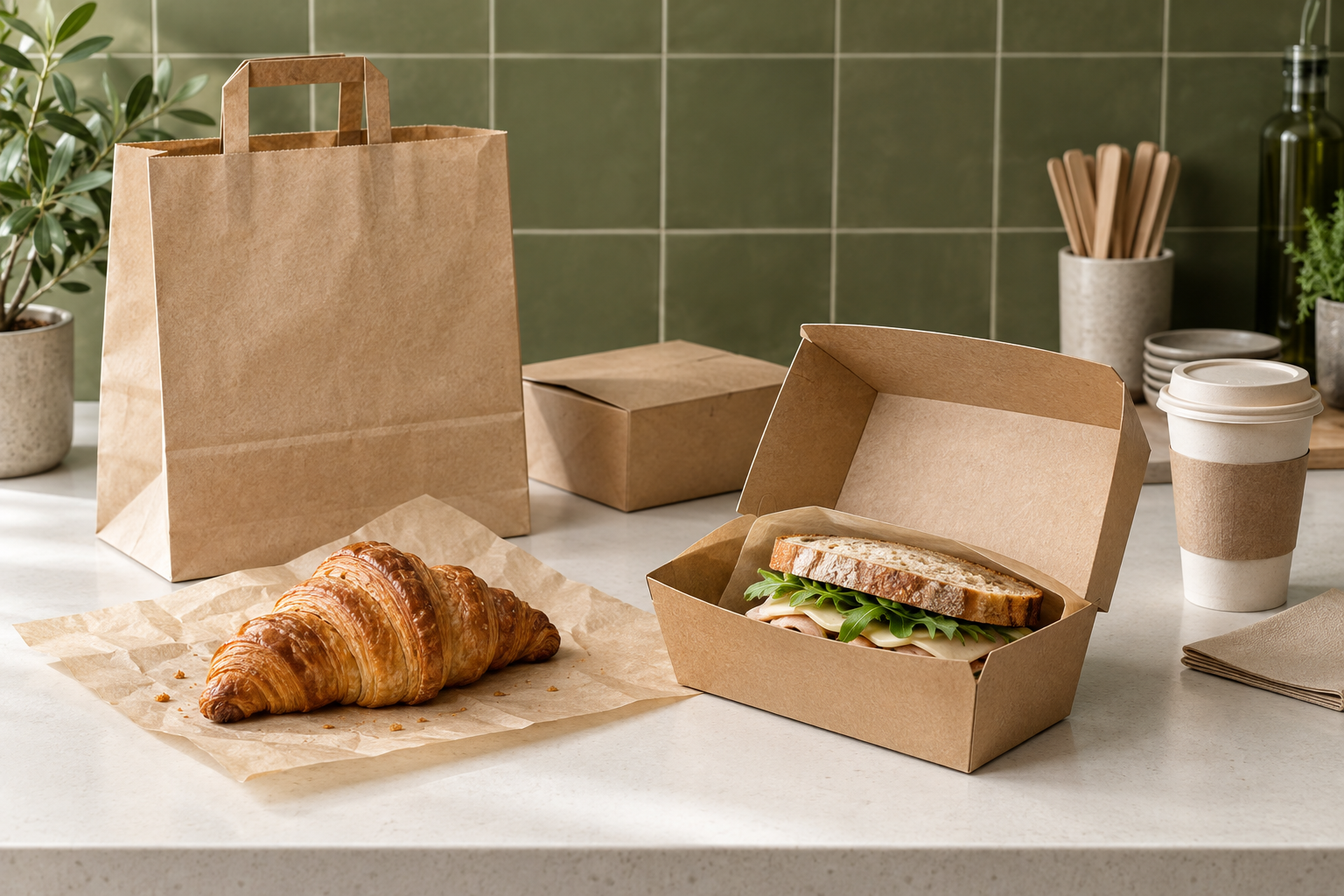
For food packaging buyers supplying the European Union, PFAS is now an immediate sourcing issue. From 12 August 2026, food-contact packaging containing PFAS above the limits set by the Packaging and Packaging Waste Regulation cannot be placed on the EU market. The European Commission highlights grease- and water-resistant applications such as takeaway packaging, bakery paper and food wrappers. Read the Commission’s announcement.
The purchasing challenge is to connect the evidence for a packaging item with the way that item will actually be used. A short marketing phrase cannot do both jobs.
Before comparing alternatives, describe the menu application. Is the packaging intended for a dry pastry, an oily baked product or a hot takeaway meal? How long will the food remain inside? Will it be stacked, transported or reheated?
These details help suppliers propose a relevant construction and help the buyer determine what food-contact documentation is appropriate. A successful cold-food trial should not be treated as approval for a different temperature or contact duration.
Ask what a supplier means by “PFAS-free” or “no intentionally added PFAS.” Request the scope of the statement and the supporting information for the actual product, including relevant coatings, inks or other components. Have the responsible compliance specialist assess whether the evidence addresses the applicable limits and the intended market.
For any test report, confirm the sample identity and construction. A report for an unprinted base material may not answer every question about a differently coated or printed finished item. Likewise, PFAS evidence does not replace the other food-contact requirements relevant to the product.
Once the documentation is suitable for review, evaluate practical performance using the intended food and service conditions. For bakery packaging, observe grease transfer and appearance through the expected display period. For takeaway packaging, assess filling, closure, stacking and transport as one sequence.
Record what constitutes an acceptable result before the trial. This makes it easier to compare options without letting a cleaner-looking sample at the start outweigh a problem at the end of service.
Agree on the approved construction before repeat purchasing, and ask for notice when materials change. A coating substitution can warrant a fresh review of both supporting evidence and practical performance.
Reviewing packaging for an EU foodservice or bakery programme? Send INTERPAC the packaging format, food application, service conditions and documentation requirements to start a focused sourcing discussion.