INTERPAC CASE STUDY · MEDICAL PACKAGING
A customer in Qatar placed an order with INTERPAC for body bags intended for a government tender project. The specified construction uses laminated nonwoven material with a waterproof barrier layer and one central zipper fitted with two sliders.
The purchasing lesson is straightforward: similar-looking body bags are not necessarily the same specified product. For tender-related procurement, the material layers, closure and acceptance requirements need to match before prices can be compared.
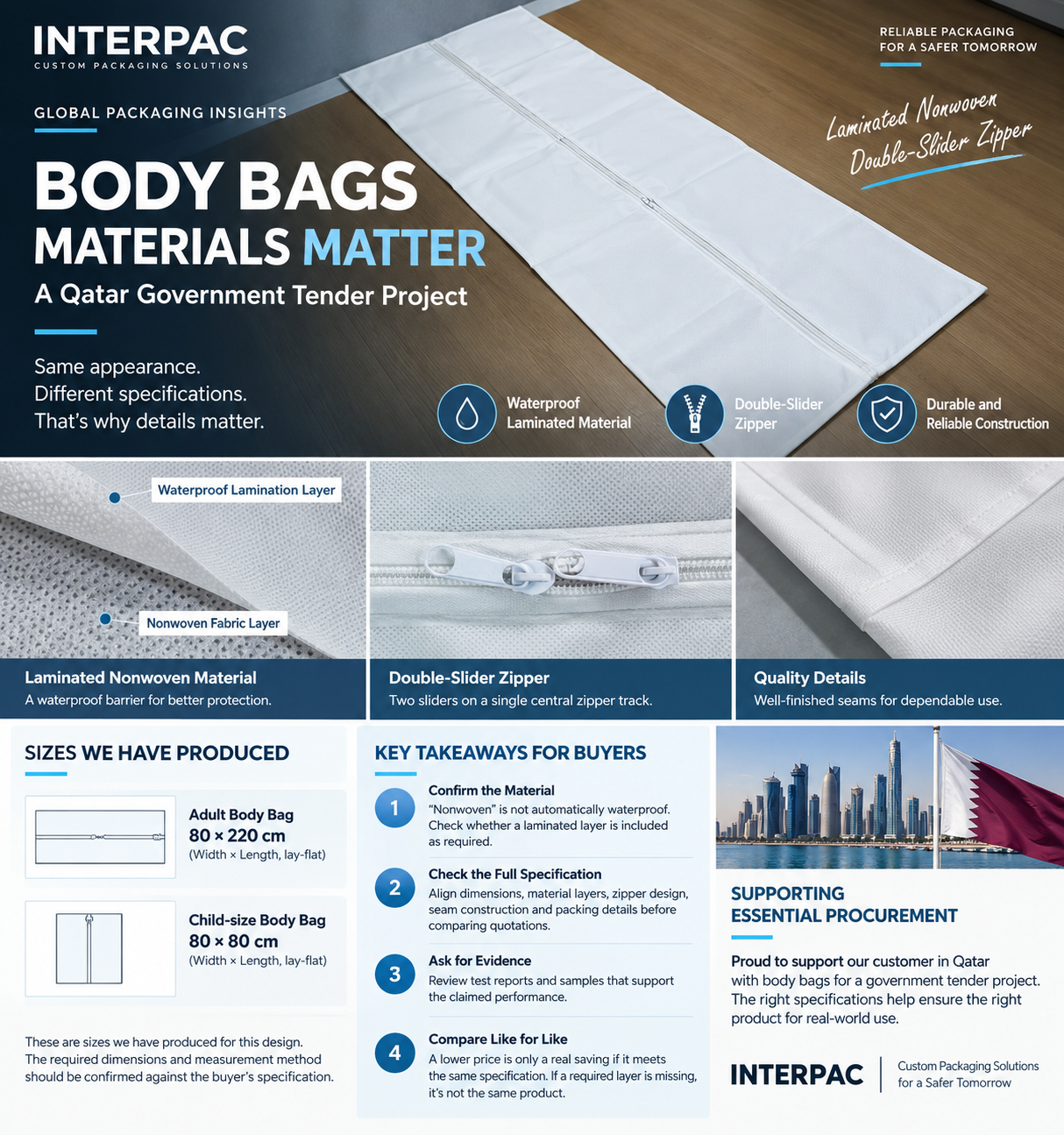
For this Qatar customer’s order, lamination is part of the agreed material construction. It is not a cosmetic finish that can be removed while treating the product as unchanged.
Consider a hypothetical comparison: two offers show white bags with the same dimensions and zipper layout. One specifies laminated nonwoven material; the other says only “nonwoven fabric.” The second description needs clarification before either offer can be judged better value. Does it include the required barrier layer, and what evidence supports the stated performance?
An incomplete quotation calls for clarification. Omitting a specified layer from production changes the product the buyer ordered.
The word “nonwoven” alone does not establish waterproof performance. Nonwovens can serve different functions: EDANA’s medical and healthcare overview describes both absorbent applications and materials with liquid-repellent finishes.
Here, the buyer required a laminated nonwoven construction. Plain unlaminated fabric would not be an equivalent substitute for that specified design. Buyers should confirm the substrate, barrier layer and agreed material weight or thickness, supported by evidence relevant to the intended use.
INTERPAC has produced this design in the following sizes, measured width × length, lay-flat:
ADULT BODY BAG
80 × 220 cm
CHILD-SIZE BODY BAG
80 × 80 cm
These are sizes we have produced, not universal standard dimensions. Confirm the required size, measurement method, tolerances and usable internal space against the buyer’s specification. A version name alone does not establish suitability for an individual use.
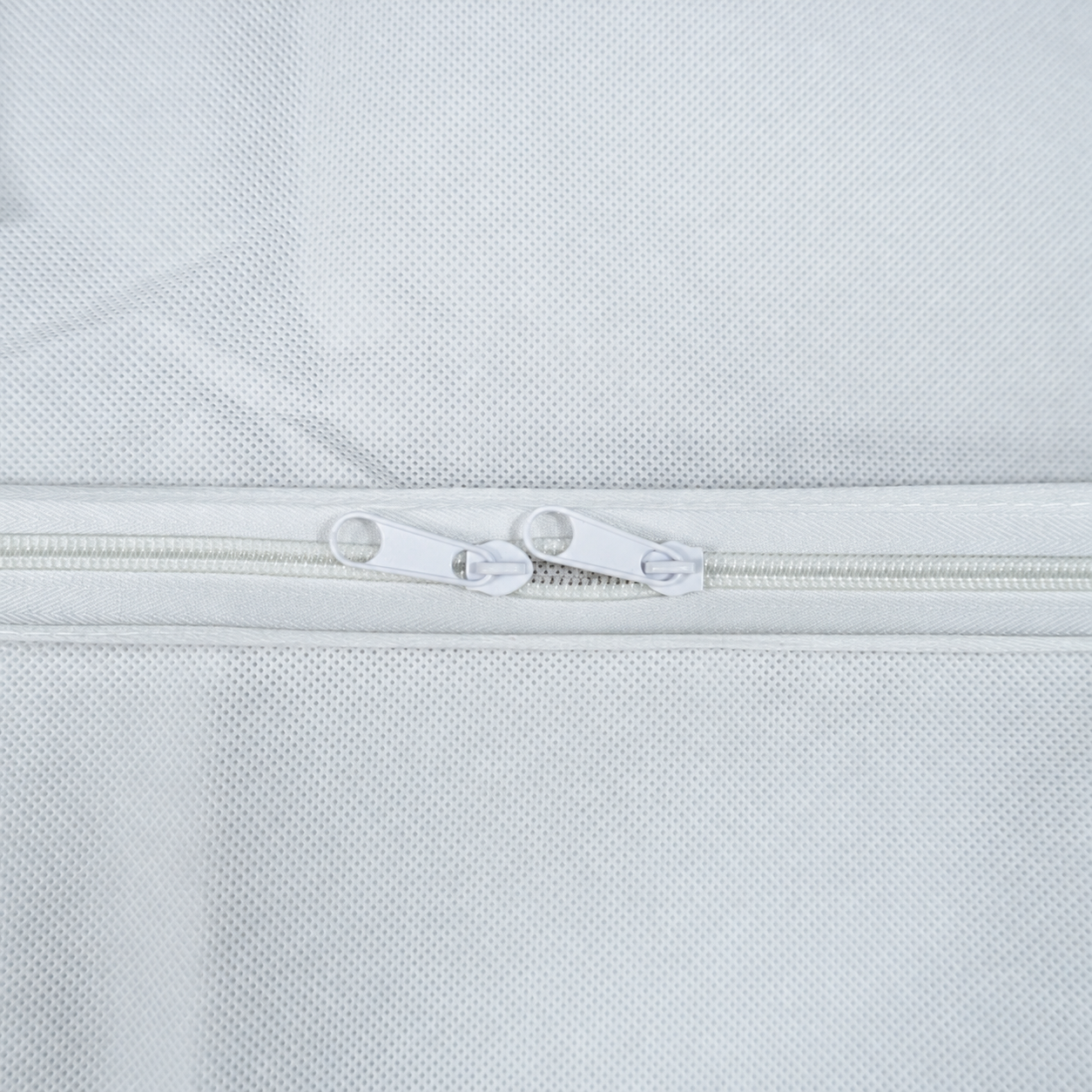
This design has two sliders on a single central zipper track. “Double-slider zipper” is more precise than “double zipper,” which could also be understood as two separate closures.
The product photographs below show the slider arrangement and operation. For a new order, confirm the zipper route, slider configuration, attachment and end construction against the approved sample. Two sliders describe a closure configuration; they do not establish a watertight seal or a carrying-load rating.
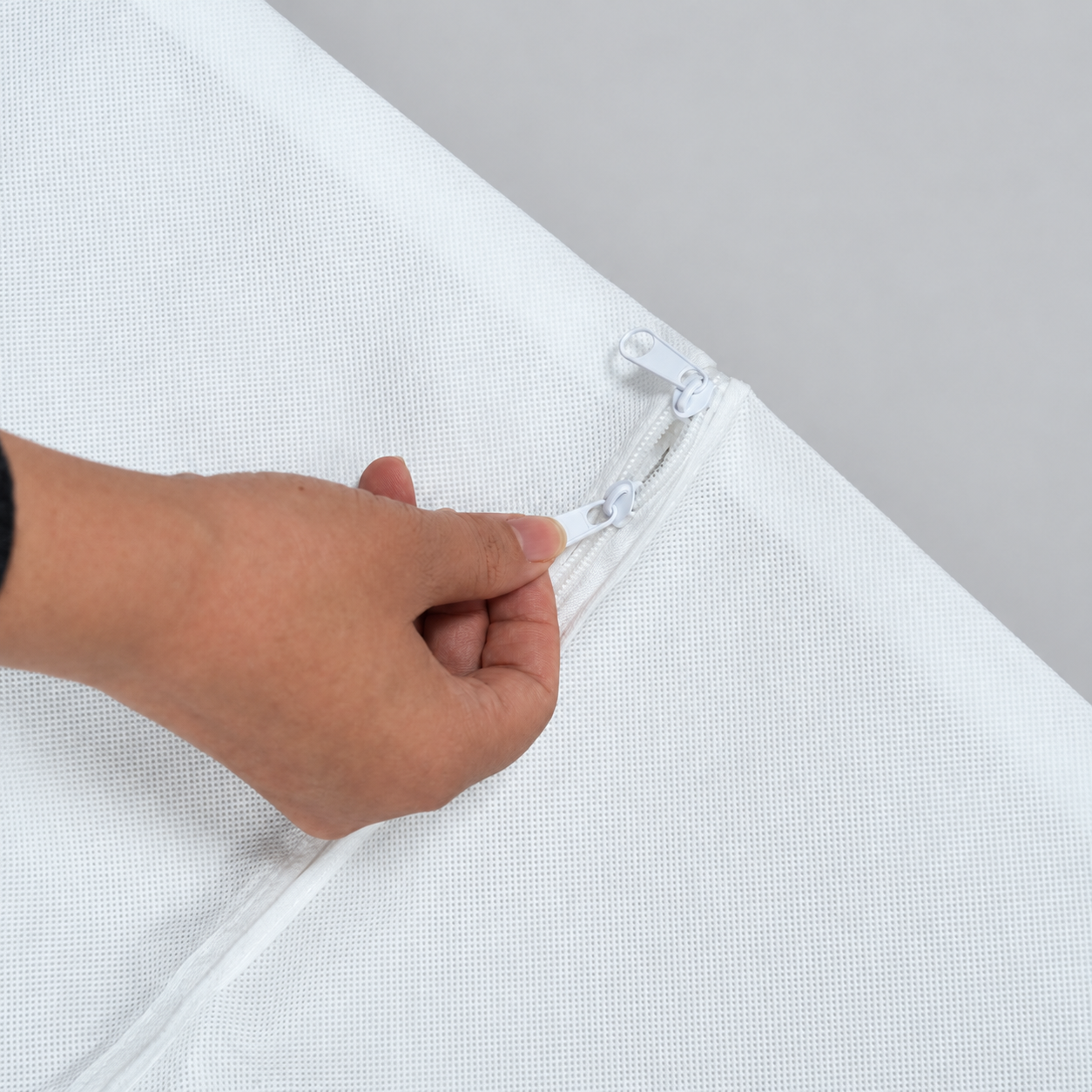
A material barrier and complete-bag containment are different performance questions. Seams, zipper attachment and closure areas also need to be considered when evaluating the finished product.
For comparison, MSF’s published specification for a separate body-bag model addresses material, mechanical properties, welds and zipper construction individually. It illustrates the need to define construction details; it is not the specification or a certification claimed for this Qatar order.
Ask what was tested—a material specimen, a seam, the zipper area or the finished bag—and under which conditions. Keep acceptance criteria and test records linked to the exact product. A waterproof-material description alone does not establish resistance to bloodborne pathogens. No finished-bag leakage, pathogen-barrier or load-test results are reported in this article.
Begin with the actual tender documents and the buyer’s approved requirements. Resolve differences before manufacturing, then compare quotations on the same basis:
| Check | What to align before comparing quotations |
|---|---|
| Material construction | Nonwoven substrate, laminated barrier layer, and the specified weight or thickness of each component. Clarify whether a quoted GSM refers to the substrate or the finished composite. |
| Dimensions | Finished width × length, lay-flat measurement method, tolerances and usable internal space. |
| Closure and seams | Central zipper route, two-slider arrangement, attachment, seam construction and end finishing. |
| Performance evidence | Required finished-bag leakage and load criteria, test methods, conditions and reports applicable to the exact product. |
| Supply and delivery | Order quantity, packing units, labelling, delivery schedule and the same agreed delivery scope. |
Where a tender names a standard or acceptance method, identify the exact document and applicable requirements. Review supporting reports and samples, and confirm that bulk production will use the approved construction. Any proposed change should be agreed before production.
A lower price does not automatically mean poor quality, and a higher price does not prove competence. But a price that excludes a required material layer is not a like-for-like saving.
Laminated nonwoven material and a double-slider central zipper were clear starting points for this customer’s project. A useful body bag quotation connects those construction details with dimensions, intended use and agreed acceptance evidence.
The right question is not simply, “Which body bag costs less?” It is, “Which offer meets the requirement we actually need?”
Preparing a body bag enquiry for a tender or healthcare procurement project? Share your destination market, required dimensions, material construction, zipper configuration, quantity, delivery schedule and any specified testing or documentation requirements.
At Interpac, we work with businesses across foodservice, bakery, beverage, medical, agricultural, retail and industrial packaging.
Explore more medical packaging insights, or send your project requirements to info@interpac.co.