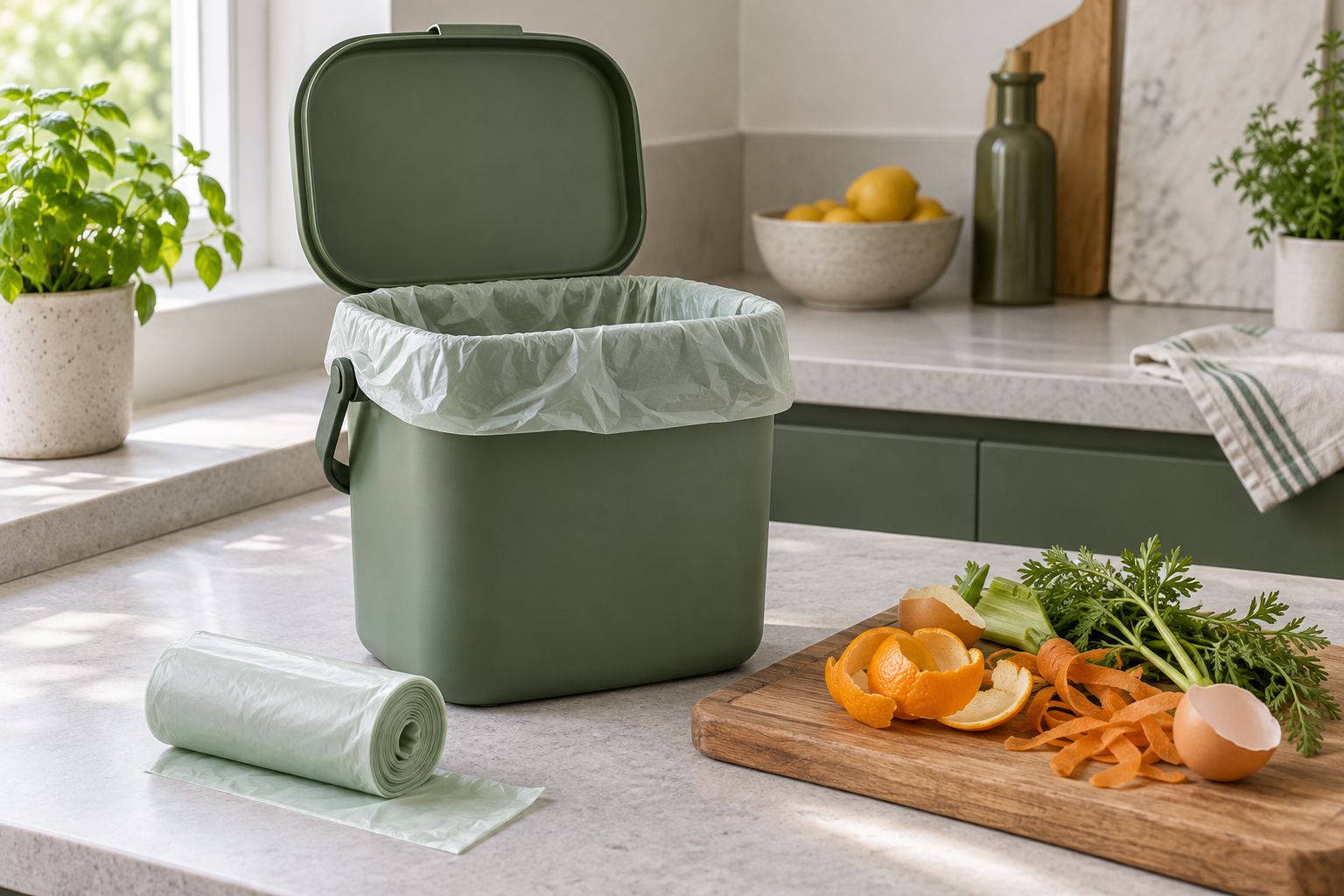
As households adapt to separate food waste collection, the small kitchen caddy is becoming a more important part of the waste-bag buying decision. For retailers and private-label buyers, the opportunity is to offer a clearly explained product that fits the local collection system.
England’s Simpler Recycling household requirements began on 31 March 2026, with later food-waste implementation dates for certain local authorities. Government guidance does not require households to use caddy liners, and it does not prescribe compostable liners as the only option. Read Defra’s household recycling guidance.
Before selecting a material or writing a pack claim, check the instructions issued by the relevant local authority or collector. A liner offered for one service may not match the instructions used in another area.
Government guidance distinguishes food-waste caddy liners from a blanket requirement to collect all packaging labelled compostable or biodegradable. For buyers, this means that a broad environmental label cannot replace a clear explanation of where the product belongs.
A litre description helps customers find a product, but it does not fully describe the fit. For a proposed caddy liner, compare the opening, base and usable depth with the caddies you intend to support. Allow for the way the liner sits around the rim and closes for removal.
An evaluation can follow an ordinary household sequence: open a bag from the roll, fit it in the caddy, add representative contents within the intended use, then close and remove it. Record where the experience becomes awkward. These observations provide a more useful development brief than asking for a “stronger bag” without describing the problem.
A retail pack should explain the intended use, dimensions or fit guidance, quantity and relevant storage instructions. Any compostability or other material claim should be supported and accurately scoped. Disposal wording should direct users to the appropriate local instructions rather than promise universal acceptance.
For a national private-label range, it may be more practical to offer carefully differentiated products than to position one liner as suitable everywhere. Make those differences visible on the pack and in online listings.
Keep the reorder specification connected to that wording. A change in material, dimensions or roll format can affect the household experience and may require an update to the product description.
Developing a household liner range? Send INTERPAC your intended sales area, caddy dimensions, material requirements and retail pack format to discuss the product brief.